
The Reptile Brain of Dixie

My novella has generated modest interest, so I am posting another chapter. Comments, either public or private, are welcome. I want engagement, not money. If you want to read the full manuscript I’ll email it to you.
When Mrs. Fuller died, sometime between the wars, the truth died with her. She never testified because her word could not be questioned. There were no rape kits back then, and the good people of Harrison County didn’t want any. A white woman said she had been violated—violated by the 21-year-old negro who worked on her farm, violated when her husband, her protector and perhaps her jealous master, was away. If Mrs. Fuller had been raped, there was a certain logic to what happened. And if she had not been, there was an uglier, crueler logic, but a logic all the same. Modus ponens and modus tollens yielded the same result.
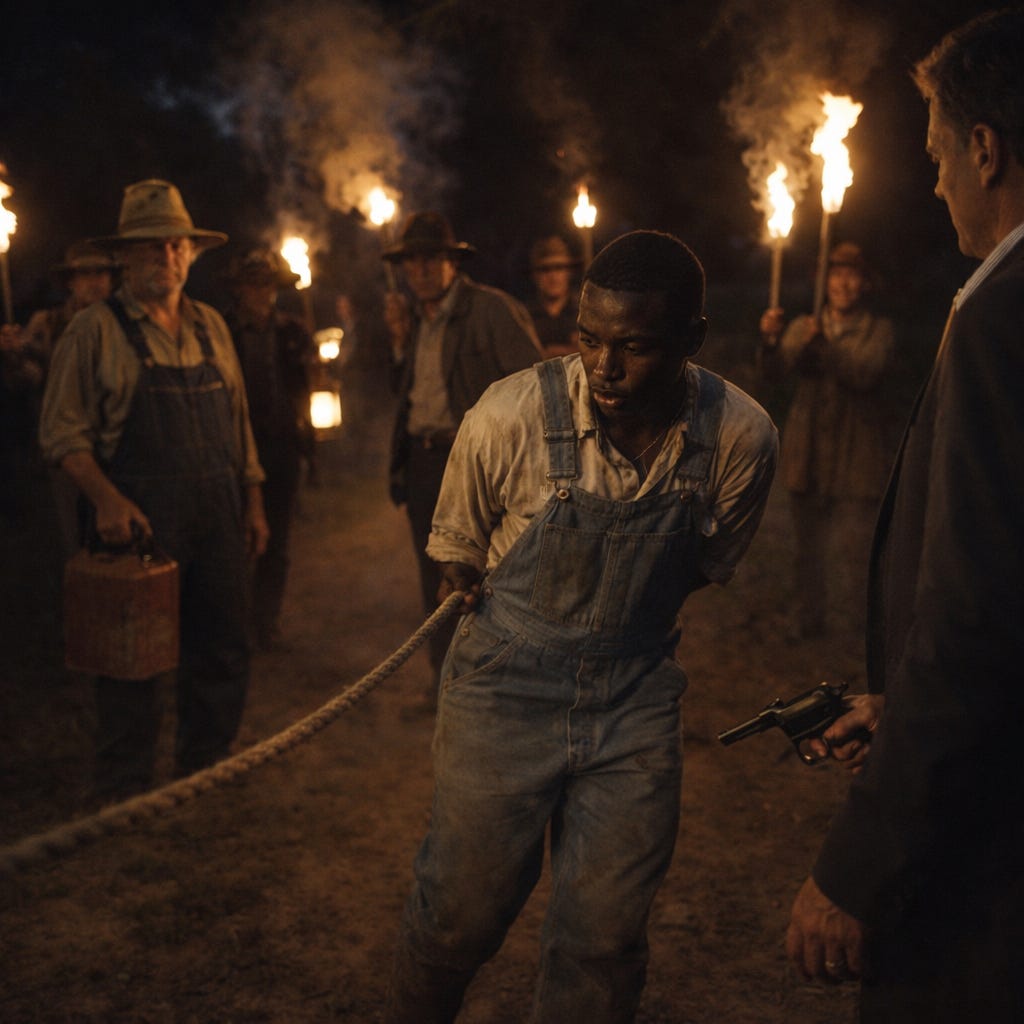
Allie Thompson had never taken symbolic logic; he probably couldn’t read. But the logic was undeniable, and he grasped it. If Allie could have run beneath a whole head guillotine and pulled the lever, he would have. But there were no guillotines in Harrison County—only nooses, guns, and kerosene.
When the sheriff’s posse caught Allie, his neck tightened and the air felt thin. He gave no insult, no provocation, wanted only to meet his fate. But the white folk of Harrison County were of two minds. The county had never seen a negro burned alive, and some thought this a failure of will and a danger to their wives. Neighboring counties had seen a handful of burnings, and many thought them exemplary.
A second, private mob with ambiguous politics and guns and kerosene seized Allie from the sheriff’s posse and hustled him toward the Louisiana line.
After a couple miles, a cotton merchant—whose father had owned Allie’s grandfather—laid his hand upon Allie and said, “Boy, did you do it?”
“Yes suh,” the young man replied distinctly.
“What did you do?”
“I got the devil in me and put it in ’er.”
A shot rang out. The hayseeds in homespun—the self-appointed guardians of farms they would never own and women who would never read—seethed and clutched their guns.
The patrician held his ground. “We don’t burn niggers here.”
The mob dispersed, half disappointed, half relieved.
One hundred and twenty-seven years after failing to deliver Allie Thompson, the Harrison County Sheriff’s Department drove Kiara from the capitol to the Harrison County Jail. The district attorney, who hunted fowl with Jude’s father, had enough fracking rigs in his circuit to claim jurisdiction. News helicopters stalked the two Harrison County patrol units as the fields grew greener and the air more humid. They drove east into the land of river snakes and river baptisms, and more sin than any river could wash away, where hellfire still licked at men’s minds and the temptations of Austin were damnation. Just before noon, Kiara arrived in the reptile brain of Dixie.
District Attorney Smith debriefed the deputies who drove her.
“What was she like?”
“Cried the whole way. Too scared to talk. Pretty, though.”
“Did she admit anything?”
“You looking for a confession?”
“I’m looking for the truth.”
“Then all I heard was whimpering.”
With the Whole-Head Guillotine Court freed from federal oversight, Smith was going to have the first real trial of his life—the kind they had in Blackstone’s day and had gone out of style under the Warren Court. Lady justice didn’t have to be blind but had as much use for peripheral vision as a Clydesdale.
Despite his nostalgia for trials that were housebroken lynch mobs, Smith was ambivalent. He wanted Harrison County to become a factory of death for real criminals. He did not want that painfully pretty cokehead to die. The trial began the next morning.
Smith called Kiara as the state’s first witness. Defense counsel—who made his name in Houston defending Enron executives—knew better than to argue the Fifth Amendment. The judge would never grant a mistrial, and the jury would distrust Kiara if she refused to speak.
Running from his client’s testimony would be like Allie Thompson running from the mob.
Smith began his examination:
“What happened the night Jude died?”
“It was an accident. Jude wanted the bear and tried to grab it. It was my bear. My ex got it for me. She grabbed and I held on. She fell and hit her head. We tried first aid, but it didn’t work.”
“Did that first aid involve holding the white powdery substance to her nose?”
“Yes.”
“And did Jude want that white powdery substance to get high?”
“Yes.”
“No further questions.”
The only other witness was Harper.
“Was there a white powdery substance in the bear?”
“Yes.”
“Was there a compartment to store it?”
“Yes, under the zipper that ran up its butt crack.”
“Did Kiara use the bear to store the white powdery substance?”
“Yes, she’d snorted some of it that night.”
“No further questions.”
Cross-examination was brief and futile.
“Did you snort the white powdery substance from the bear?”
“Yes.”
“Are you worried about going to prison?”
“Yes.”
“Did Mr. Smith or any of the deputies promise you anything?”
“No.”
“Did you talk to Mr. Smith before the trial?”
“Yes.”
“What did he tell you?”
“Tell the truth.”
“That’s it?”
“Yes.”
“Do you really expect us to believe—”
Smith objected. “Asked and answered, cumulative, and badgering.”
The Court: “Sustained. This cross is dragging on too long.”
“No further questions,” said defense counsel.
“The state rests.”
“Oh shit,” thought defense counsel. It was only 9:23 a.m. His character witnesses weren’t arriving until the next day.
Still, the state hadn’t called a chemist. There was no proof the white powder was cocaine. No cocaine, no underlying felony, no felony murder. This argument would have worked anywhere else. It had no force where UNCUCK reigned. The judge denied a directed verdict with a single word.
In closing, defense counsel—still refusing to say the word cocaine—argued Jude’s death was caused by her own attempt to possess the white powdery substance, not by Kiara’s determined embrace of Mr. Buttons. The jury rocked in their swivel chairs.
Smith’s closing was better.
“We may not be Houston, we may not have skyscrapers and BMWs and sixty-dollar steaks, but we do have common sense. Any white powdery substance people use to get high is an illegal drug. Might be cocaine, might be meth, but it’s certainly a felony. Jude is dead because Kiara wanted that cocaine. Take that cocaine out of Kiara’s hands and Jude would still be with us today. The defense wants you to split hairs. The state just wants common-sense justice.”
After the jury retired to deliberate, Smith checked his email.
From: Sally Heines
Re: Testimony at Capital Trial
The sample tested positive for cocaine. When do you need me to testify?
“Never,” Smith thought.
A couple minutes later, the jury returned: nine votes for conviction, three for acquittal. The Texas Whole Head Guillotine Act made no provision for mitigating evidence, and the judge didn’t ask for any. He placed a black napkin on his head and said, “I sentence Kiara Fitzroy to death by whole-head guillotine. I already texted notice of conviction to the Whole Head Guillotine Court. The appeal will be heard at noon tomorrow in Austin.”
The court adjourned at 9:32 a.m.