
Lindsay Vonn Chose Glory

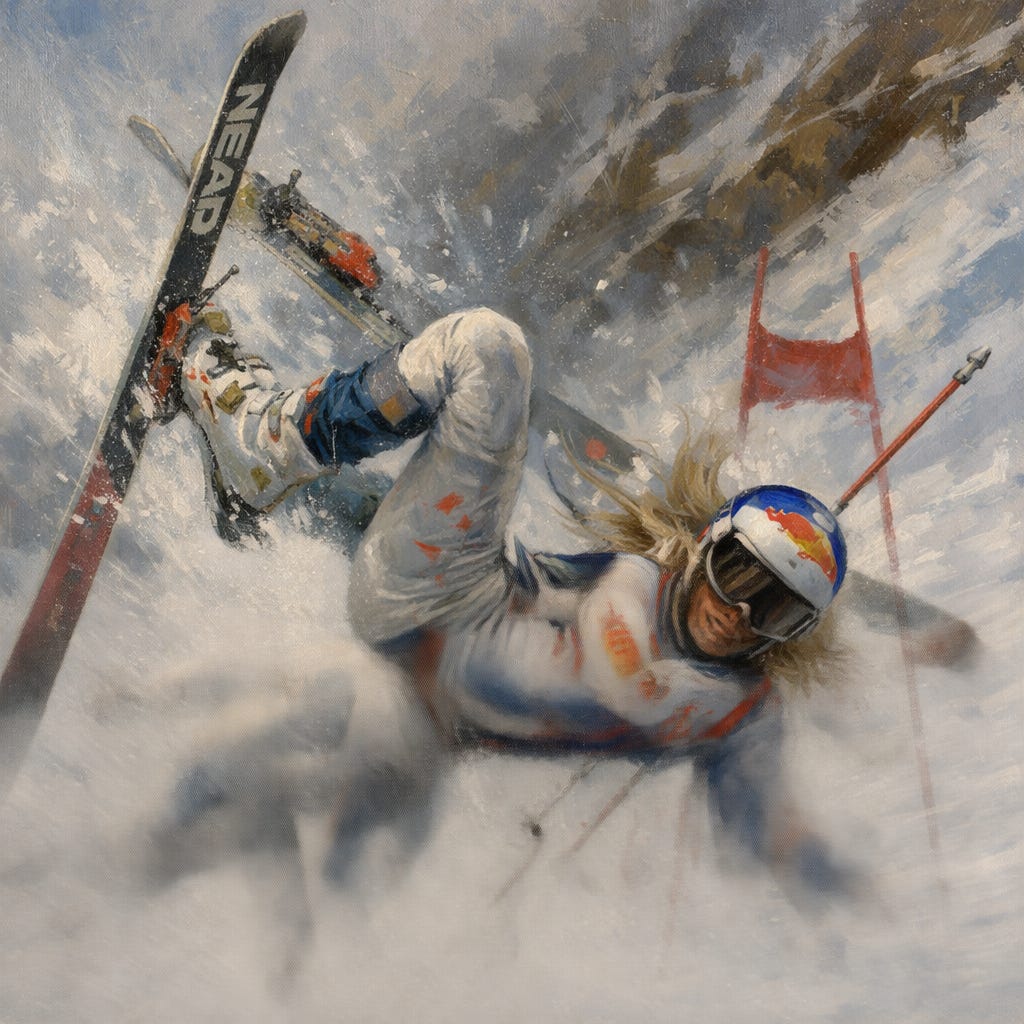
Watching Lindsey Vonn crash was painful, but the reaction afterward revealed something darker than concern for an injured athlete. It exposed a modern discomfort with risk, glory, and the kind of striving that once defined sport.
Vonn is forty-one years old.
She returned from injury a week before the Olympics.
She entered a downhill event where the margin between triumph and catastrophe is measured in tenths of a second and inches of edge control.
And she went for it.
Some critics call this reckless. They point to the injury, the fall, the safer finish she might have secured by skiing conservatively. But this criticism misunderstands both elite sport and Vonn herself.
She was not trying to finish tenth.
She was trying to win.
Anyone who watched her training run could see it. She skied broad, conservative lines with enormous skill. She rarely held her tuck for long. She looked nothing like the intrepid twenty-something who thrived on the edge of disaster. Her training time of 1:38.2 was only 2.1 seconds off the winning mark on race day, good for 17th place. A respectable Olympic finish was available. Vonn had other plans.
Great downhill skiers are not remembered for prudence. They are remembered for the willingness to accept real danger in exchange for a small chance at something transcendent. Speed amplifies consequence. Commitment erases retreat. Every run is a decision about how much risk one is willing to bear. It is poker with your body at 85 mph.
Even the mechanics of the crash reflect this logic. Watching the replay, you see the shearing at the gate, the early transition into a controlled fall, the absence of any desperate attempt to salvage the landing. This is not amateur chaos; it is elite risk played to the edge. Anyone who has ever caught unexpected air knows the skill Vonn showed in committing to a controlled fall.
Which leads to the question critics avoid:
What is the proper price of glory?
A broken leg is terrible in ordinary life.
It is a risk any skier who hopes to win an Olympic downhill must accept for years. Had Vonn refused that risk as a teenager, we would not even know her name.
Elite sport is not organized around safety. It is organized around excellence under danger. Remove the danger and you remove the meaning. What remains is exercise, not glory.
At forty-one, the stakes are different. Time compresses opportunity. Future chances disappear. The remaining window demands boldness.
An Olympic victory in her fifth decade—on one reconstructed knee and one natural knee without an ACL—would not merely have been impressive. It would have ranked among the most extraordinary achievements in the history of sport, alongside the first four-minute mile or the first two-hour marathon.
Vonn risked her body to give the world a real chance to witness a triumph of the human spirit over injury and time. The chance was small, but it was beautiful. I place Lindsey Vonn in the company of Shackleton, Amundsen, and Sir Edmund Hillary.
Yes, she crashed.
Yes, she was injured.
Yes, a cautious run might have avoided it.
She chose glory.
I’m glad she tried.
Made me cry!
"I’m glad she tried."
Why?
Yes, she chose glory. But one must ask, what is glory for entertainment purposes worth? Have you really produced something of value for humanity? Was your self-gratification worth it?