
American Nawab

This is the funniest thing I’ve written yet. I’m holding into several other chapters until the novella is done, but I couldn’t resist sharing this.
Earl Dodson never expected to become a world-historical figure. Phil thought the Whole Head Guillotine Court would be a rubber stamp. The governor chose Dodson mainly because his team, the Coronado Mustangs, had a rich booster network and Dodson seemed eager to please.
Dodson didn’t become a high school history teacher by being dumb, and he didn’t become a district champion coach by following other people’s playbooks. He had pioneered an offense he proudly called the Three-Headed Monster. The main quarterback would take the snap, and the two best all-around athletes on the team would stand in echelon on either side. Any of the three could run, pass, or receive. There were three wide receivers, who lined up in completely unpredictable ways, and never more than five down linemen. The rules required five, so he had them, but down linemen were never eligible receivers and that made them a waste. Coach Dodson loved options. Options were efficient. That cunning won Coach Dodson three district championships and, eventually, his seat on the Texas Whole Head Guillotine Court.
Dodson’s baccalaureate degree from San Angelo State gave him a better legal education than John Marshall. His credentials were somewhat inferior to those of Oliver Wendell Holmes, whom he considered a cuck.
On August 7, 2030, Coach Judge Dodson left the Mustangs’ dawn practice early so he could hear appeals in Austin. In the court’s first year—before the ethics board existed—Coach Dodson had been at the mercy of Lubbock airport’s commercial schedule. There was only one direct flight to Austin each day. It was early enough to make a 10 a.m. meeting, but utterly incompatible with football season, when 6 a.m. practices were the best defense against heat stroke.
The ethics board solved this problem — and many others — through its Mission Statement:
Mission Statement of the Whole Head Guillotine Court Ethics Board
1. Members of the Whole Head Guillotine Court are citizen-judges deeply involved in their communities.
2. Judges will not and cannot be bribed.
3. Facilitating community participation is not a bribe.
4. To this end, help with transportation logistics, including official vehicles, helicopters, and jet service, is never a bribe.
5. Single-engine aircraft, other than helicopters, are inherently dangerous and not fit for judicial travel.
6. Gifts to high school sports teams or to the Air Wing are never bribes.
7. Each member of the Court may maintain one official residence in his home county and a second in the Capitol.
8. Stipends for maintaining official residences are never bribes.
The ACH160 helicopter the Ethics Board kept at Dodson’s disposal was invaluable. Lone Star Fractional Aviation kept the billionaire’s Amex Black on file as “Civic Partnership Account 001” and no one asked too many questions. The Court’s elocution consultant rode with him, correcting Dodson’s French vowel sounds above the hills and prairies.
Coach Judge Dodson had become the face of the Texas Whole Head Guillotine while Phil Mason had retired from public life. If Coach Dodson was sharper and less supine than Mason expected, he shared Phil’s essential belief that criminals were dumb brutes and dumb brutes didn’t want their heads bashed in. He had stumbled onto the deepest truth in criminology and wanted credit.
Dodson had gotten into regression analysis optimizing his Three-Headed Monster. He took that same acumen to Harvard, Yale, and Paris Deux, where he calmly accused progressive luminaries of dithering while blue-staters were murdered at two or even three times the Texas rate. The statistics backed him up. Murder in Texas fell by 53% the first year and another 60% in year two. At this point, crime stabilized, and liberals began to question whether the Whole Head Guillotine had already done its work. Coach Judge Dodson wasn’t going to risk pulling the plug.
He was annoyed that Texas’s murder rate was still higher than Massachusetts’s. The problem was Texas, which was inhabited by Texans, would always be bloodier than Massachusetts, which was not. The regressions proved this, though Dodson knew not to say the quiet part out loud. If New York signed on, a guillotine state with a real urban population might finally beat Massachusetts. That was the holy grail—the argument no amount of credentials or p-hacking could refute.
Behind Dodson’s desk hung exactly three framed photographs. In the center was John Marshall. On the left, two inches lower, as if prepared to catch a lateral, was Dodson’s first district champion team, the 2007 Mustangs. On the right, a couple inches lower than the district champions, was an official portrait of Chief Justice Roberts.
A few clerks asked why Scalia wasn’t in the pantheon. Dodson always answered:
“Three’s a fine number. Three quarterbacks, the judges on our court, three pictures on my wall.”
Only his authorized biographer — sworn to silence until the day Dodson hangs up the robe and the whistle — knew the real answer. One night, after a long day on the bench and half a bottle of Shiner Bock, Dodson spilled the beans.
“Judicial restraint is for losers who like moral victories. Nino wrote masterpieces for thirty years, but spent the whole time begging legislatures to grow a pair. Cruz is worth a dozen Scalias. I don’t hang participation trophies.”
“Johnny Boy knew how to throw a party in high school — knew it so well it almost cost him a Senate confirmation. He knew that money was speech and speech was power and that broke-ass Democrats shouldn’t mess with that hierarchy. He knew how to gut the Affordable Care Act with a straight face. Scalia just sang songs about his own impotence. Roberts seized the day.”
⸻
interlude
Dodson thought that the smartest man who ever lived was a Bengali peasant who died in 1642. This genius left no trace in the historical record, but his existence was stochastically likely. Dodson knew there was also a healthy chance he lived in China any time during the past three millennia, but preferred the Mughals because India had never gone communist or hosted the Wuhan Virology Institute.
This man, whom he called Rajiv, wasn’t educated. He wasn’t even literate. Rajiv lived his entire life inside five miles of wet soil and did exactly two things better than any fancy academic alive: he kept people fed, and he kept himself in charge.
Rajiv noticed that the first, precious rains of the monsoon evaporated slower if you dug the irrigation channels narrow and deep. If you kept them narrow, you could cover them with palm fronds, which often stayed in place during the calm, languid days of May. The real monsoon would blow them away, but you didn’t need them once the rain began in earnest.
Rajiv’s system worked so well the local zamindar made him headman. He never learned to read. He never saw a map. He never held a coin worth more than a few rupees. But he took a village that had been hungry every third year and made it hungry every seventh.
Dodson would do the same for Texas.
⸻
Conrad Langford III — shale tycoon, megachurch benefactor, and longtime believer that civilization was one riot away from collapse — had followed the Court’s early success with something close to religious awe. Murder down 53% the first year, 60% the second. Fewer burglaries. Fewer carjackings. More families eating dinner outside again.
He admired effectiveness. He admired fear. He admired men who did not apologize.
Then his daughter went and spent a night in Marfa with a 27-year-old whose résumé consisted of a SoundCloud link and a suspended driver’s license. Conrad rewrote his will before breakfast.
She would get $20 million — “enough to correct her taste,” he told the lawyer.
The remaining $4.3 billion would go to the Whole Head Guillotine Court Endowment.
Langford died nine months later. The Court became a trust-fund baby overnight.
The ethics board, on which all three judges sat, could not agree on how to use the windfall. Dodson wanted to endow dozens of academic chairs to study the guillotine court and nitpick the decisions of Kagan and Scalia. Judge Crowell, the exterminator, disagreed.
“Earl, let’s speak plainly,” Crowell said. “You want your name in casebooks and journals and on the nameplates of academic buildings. Fine. But we need something carved for us too.”
Dodson narrowed his eyes. “Which is?”
“Life tenure.”
Mendoza nodded instantly. He had been waiting for someone else to say it first.
“It gives us equal dignity with the federal judiciary,” he said, emphasizing equal dignity like it was a biblical commandment. “And it keeps any future Phil Mason from stacking the Court with cronies.”
Crowell added: “And it anchors the endowment. Foundations don’t like courts that turn over every four years. Permanent judges, permanent money.”
Dodson felt the air shift. He’d been fighting for scholarly legitimacy while these two had been thinking about power. Was he going soft?
Crowell continued, “Look, Earl — you get your ivory-tower nonsense. Chairs at A&M and UT. Both. Named after whoever you want. Hell, name them after that Bengali peasant of yours. The one who dug the ditch.”
Mendoza nodded again. “And we get tenure. Actual tenure. The kind you have to get impeached to lose. You like your regressions, but I know you love your official residence.”
For a second, Dodson wondered if he were turning into a dickless intellectual or, even worse, Scalia. He hated how much sense the other two made.
“You realize,” Dodson said, “the legislature will scream bloody murder.”
“They’ll get over it,” Crowell said. “They need campaign contributions and voters don’t care about procedural mumbo jumbo.”
“And the governor?”
“He wouldn’t dare veto a bill to protect the court that’s keeping Texas safe. Legislators can get away with stupid votes because no one is watching, but the governor cannot target the most popular court in the country.”
Dodson drummed his fingers on the table. Power was a poor substitute for immortality, but it was still power. And the thought of two endowed chairs — one at UT, one at A&M — sent a warm pulse through the part of him that still wasn’t sure he had outshone John Marshall.
“Fine,” he said. “We spend $500 million pushing life tenure. And I pick the chair holders.”
Mendoza shrugged. “No one else wants the job.”
Crowell grinned. “Then it’s settled.”
⸻
Gravity PAC’s best ad:
A deep, confident voice:
“In just two years, the Texas Whole Head Guillotine Court cut murders by seventy-five percent and saved more than three thousand Texas lives. But Democrats and RINOs in Austin want to gut it.
Federal judges have life tenure to shield them from politics. Our guillotine judges need the same protection.
Louis Brandeis worried about the ‘brooding omnipresence of reason.’
Coach Chief Judge Dodson knows this is a pansy substitute for killing criminals.
Elena Kagan defers to Washington bureaucrats who despise Texas, its people, and fracking. Dodson and his court defer only to Texans.
Martin Luther King said the arc of the moral universe is long.
Coach Chief Judge Dodson bent it toward justice.
[The camera pans to white and Latino children playing happily by a reflecting pool.]
Keep Texas safe.
Call your legislator today and demand life tenure for the Whole Head Court.
Paid for by Texans for Permanent Justice.”
⸻
The morning after life tenure passed, Justice Crowell tried to be cute.
“Earl, you oughta call that new place of yours Mount Vernon.”
Dodson didn’t even look up from his eggs.
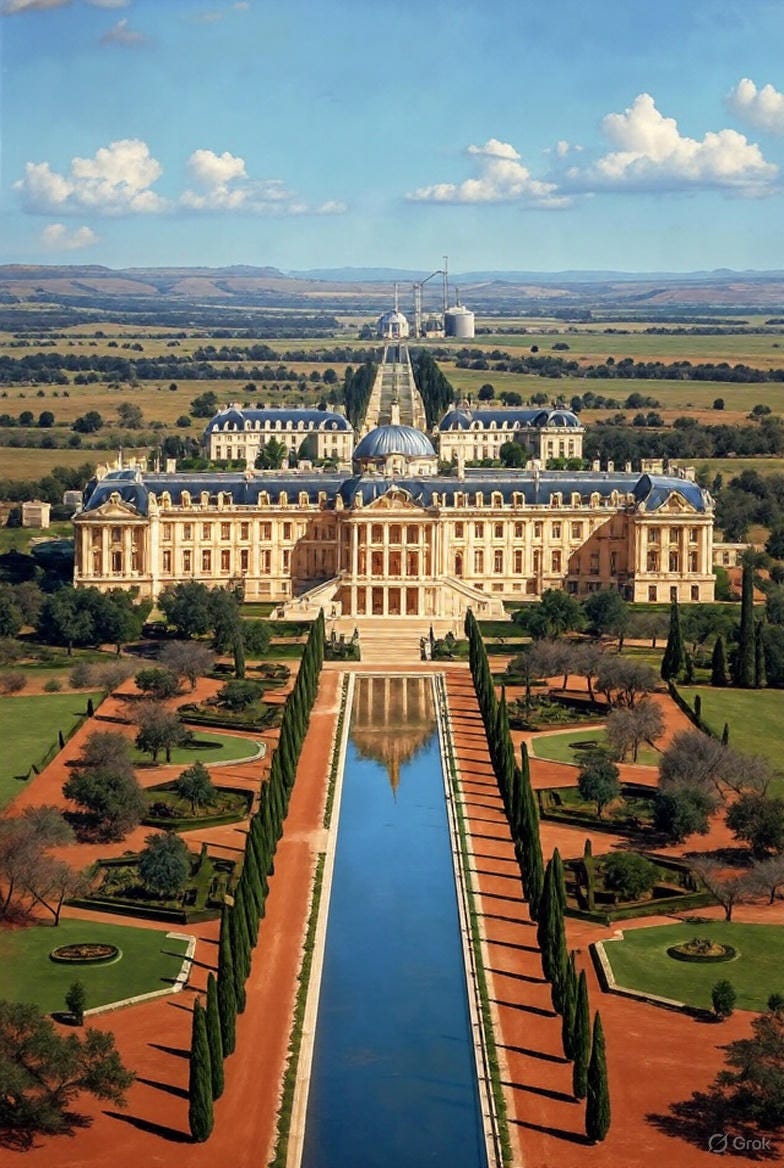
“Mount Vernon didn’t have a reflecting pool. It didn’t have axial water features, or a salon des glaces,” he said. “Washington was essentially middle class.”
By lunchtime the nickname had spawned — first as a joke, then as a creed. By sundown, the Official Coronado County residence of Coach Judge Dodson had an official name:
Our Versailles.
Dodson embraced it immediately. He had worked his way through three chapters of Michelet and come to see a lot of himself in Louis XIV. The turbulent childhood, the bad marriage, the fight for useful splendor. Louis had built the greatest palace in the world, neutered the nobility, put his grandson on the Spanish throne, and had several official mistresses. Not bad.
The Landscape Architecture Division of the Ethics Board straightened the hedges into perfect lines — lanes, really — so that anyone approaching Our Versailles felt funneled, committed, unable to audible out of the encounter. Dodson expanded the reflecting pool until it was visible from the county road and insisted the contractor understand the phrase “grand axial approach.”
The Court acquired three Italianate statues from a bankrupt ranch outside Kerrville and placed them at mathematically identical intervals — positioned like the Mustangs’ Three-Headed Monster.
“That one’s the primary,” Dodson would say, tapping the center statue. “Other two are options.”
Inside, gilt frames held Marshall, Roberts, and the ’07 Mustangs in an arrangement that confused art historians and delighted alumni boosters. It was part Bourbon, part UIL semifinal.
⸻
Emboldened by life tenure, Coach Chief Judge Dodson lectured at Paris Deux, no longer afraid to speak French in public. Being snubbed by the Sorbonne was no reason to miss Paris. Dodson wanted to give a speech extolling the Texas guillotine at the Place de la Concorde — a place he revered almost as much as Canton, Ohio — but his French hosts thought it poor form for the Master of Our Versailles to speak there.
At the suggestion of Marie Le Pen, Dodson went to Foucault’s tomb instead. He was accompanied by Le Pen, two leading deputies of her party, and a handful of semi-literate mayors from the Massif Central. Dodson read from a paperback copy of Surveiller et Punir:
“Le 2 mars 1757, Damiens fut condamné à faire amende honorable devant la principale porte de l’Église de Paris, où il serait conduit et amené dans un tombereau, nu, en chemise, tenant une torche de cire ardente du poids de deux livres… puis, dans ledit tombereau, à la place de Grève, on lui arracherait la chair avec des tenailles, et on lui couperait le poing.”
He let the sentences unspool like a perfectly timed play-action fake, every syllable crisp, every verb in its place.
When he reached the part about the boiling lead and the four horses, he stopped, closed the book, and looked down at the headstone.
“Y’all quit too early, Michel,” he said, voice soft, almost affectionate. “That’s why we brought the show to Texas.”
⸻
Coach Judge Dodson’s jurisprudence was simple. Juries were crap. It wasn’t that every capital defendant needed his skull crushed. Some yahoos in the legislature might think that, but Dodson didn’t. The problem, like most legal problems, was jurisdictional. The Whole Head Guillotine Court had no jurisdiction until the defendant was convicted, because Phil Mason had been too cheap or too stupid to establish guillotine trial courts. Every not-guilty verdict shrank the jurisdiction of the guillotine court. Jurisdiction was power, and power was what Earl needed to make Texas safe and achieve useful splendor. Only when power was centralized would Dodson get the credit he deserved.
Before he wore a robe, before he ran a single regression, Earl Dodson had read the Oxford History of Britain in college. He remembered at least one thing that mattered: pocket boroughs work.
He set out to create three. Having only one friendly venue would be like running an offense with a single quarterback. Whoever wanted to bust his balls would know exactly whom to wheedle or bribe, and he’d take a sack. But let three nothing-counties vie to become factories of death for a state of thirty million, and Earl Dodson’s jurisprudence could spread its wings.
Loving County, population 64; King County, population 265; and Roberts County, 827, would be the new Three-Headed Monster. The key was the Permian override. Each of these counties had more than enough fracking rigs to qualify. If any of the three district attorneys wanted to drag a Dallas or San Antonio murderer to a rural trial, the only question was who would do it first.
In the first five years of Dodson’s tenure, these counties produced 654 convictions and 1 acquittal. The jurisdiction of the Whole Head Guillotine Court reigned supreme. When the regressions said mercy, Dodson gave it. When, as was more common, they called for blood, the cylinder dropped. Either way, Dodson got the credit.
Bengal never produced as fine a Nawab as Earl Dodson.